
Investment Banking Recruiting Timeline: When to Apply for Every Wall Street Role
Nov 11, 2026By Yang Song, founder of Wall Street Smart · Updated November 2026
On Wall Street, when you apply matters almost as much as what's on your resume. Most firms review applications on a rolling basis, so the strongest candidates often lose seats simply by applying after the first wave of interviews has gone out. And each type of role runs on its own calendar.
Why "rolling" is the real rule: A posting may say applications are open until a set date, but in practice hiring is rolling. If a firm has 10 highly qualified applicants for 2 seats in the first week, why would it wait for the window to close? The only reasons to wait are that the seat doesn't need to be filled right away, or that the role is so specialized only a few top candidates matter. Otherwise, the earliest strong applicants get the interviews, and the seats.
Here's when each one opens, how early to be ready, and what your year should look like.
Summer analyst internships: earlier every year
The window: Ten years ago, students recruited in junior year for the junior summer internship. Today, investment banking summer recruiting happens in sophomore year, for both summers at once. The pattern shows up in the postings themselves: by November 2026, US banks had already posted internships for summer 2028, about 20 months ahead. During sophomore year you'll be applying to sophomore summer programs (for the summer right after sophomore year) and to the junior summer analyst internship (the summer before senior year), which banks now recruit for well over a year ahead. Elite boutiques and middle-market banks tend to follow the large banks within weeks.
Why it matters: The junior summer internship is the most direct way to a full-time offer (more on that below), and most of its seats are decided while you're still a sophomore. Waiting until junior year means waiting until most of the class is already filled.
How fast it closes: It depends on your school. At some schools, banks recruit on campus with strict windows and a formal timeline for when applications open, when interviews happen and when offers go out. Everywhere else, hiring is rolling: interviews start almost as soon as applications open, and seats fill as offers go out.
Buy-side and trading firms: Hedge funds, prop trading and quant firms usually post their summer internships closer to the summer. In Career Intelligence's data, most summer 2027 internships at these firms were posted between July and September 2026 (the summer before and the fall of junior year), with a few as early as March. Large private equity firms hire few undergraduate summer analysts, and those that do often recruit on the bank calendar.
Europe and Asia: Summer programs open in the year before the internship, a little later than in the US. In Career Intelligence's data, banks posted most summer 2027 internships in Europe between August and October 2026 (mostly September), and in Asia between July and October 2026 (mostly July and August).
What to do: Have your resume, technical preparation and networking in place well before the window opens. If you're starting to prepare when applications go live, you're already late.
Off-cycle internships: rolling, all year
The window: Off-cycle roles (seasonal, spring, winter or industrial placements, often 3 to 6 months long) are posted year-round, usually 3 to 6 months before the start date. There's no single season.
How fast it closes: Because they're posted one at a time, the first applicants get the first interviews. Some close within weeks.
What to do: Check regularly rather than once a season. Off-cycle roles aren't only a second chance if you missed the summer cycle: they're also one of the best ways to build your resume for the summer cycle, and a common route in Europe.
Full-time analyst roles: mostly decided by the summer before
How the class is filled: Think of a bank's analyst class of 100. Roughly 90 of those seats are filled by its own summer interns through return offers. That's by design: hiring from the summer class is easier for the bank and its HR team, because they've already seen each intern do the job for ten weeks. Ideally the bank would fill all 100 that way.
The remaining 10 or so seats open up because some interns don't get a return offer, and others turn theirs down: they want a different city, didn't click with the people or the culture, or are shopping for a better opportunity elsewhere.
The window: Those leftover seats are what full-time analyst postings are for. They usually open in the summer and early fall of your final year, often with a start year in the title (a "2027 Full-Time Analyst Program" starts in summer 2027).
How fast it closes: Quickly. With only a handful of seats per bank, these postings draw every final-year student without a return offer.
What to do: Apply the week a posting appears, and widen your list to off-cycle roles and smaller firms at the same time.
Insight, shadow and diversity programs: the earliest of all
The window: These short programs, including women's and other diversity programs, mostly target first- and second-year students and usually open early in the academic year, often a full year or more before you'd recruit for a summer analyst role.
Why the timing matters: Many feed directly into summer recruiting. Attending one can mean an early interview, or even a fast-tracked offer, before the main summer window opens.
What to do: Recruiting doesn't start in junior year, or even sophomore spring. It starts in the fall of freshman year, so apply to these programs then.
Experienced-hire roles: whenever a team needs someone
The window: Year-round, as teams need people. There's no cycle to plan around.
What to do: If you're already working, check often. Good roles can be filled within days of posting.
A year-by-year calendar (US undergraduate)
| When | What's open | Your focus |
|---|---|---|
| Freshman fall to spring | Insight, shadow and diversity programs | Apply to early programs; start networking; build basic technicals |
| Sophomore year (fall to spring) | Investment banking summer recruiting for both summers: sophomore summer programs and the junior summer analyst internship | Resume, networking and technicals ready by the start of the year; apply on day one, since interviews can start within days |
| Sophomore summer | Your sophomore summer program; hedge fund, trading and quant summer programs start posting | Do well, keep networking, start buy-side applications |
| Junior fall | Most hedge fund, trading and quant summer programs; any bank seats still open | Add buy-side and off-cycle roles |
| Junior year, all year | Off-cycle internships (rolling) | Check weekly as a backup and a second chance |
| Junior summer | Your summer internship | Earn the return offer |
| Summer before senior year to senior fall | Full-time analyst roles for students without a return offer | Apply the week they post; widen your list |
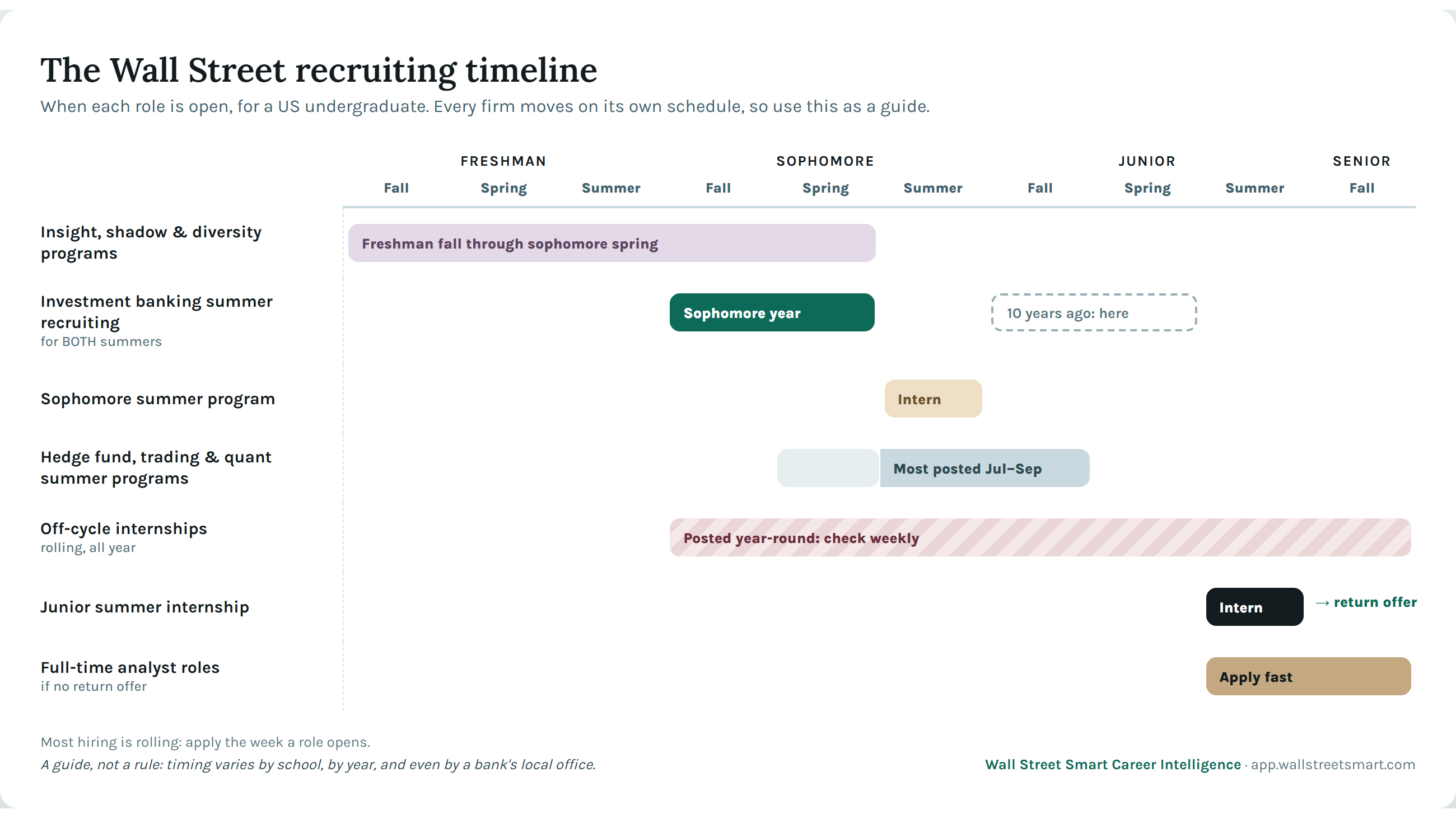
Every firm moves on its own schedule, and the calendar shifts a little each year. Use this as a guide, not a guarantee.
These are guidelines, not universal rules. Recruiting can look completely different from one school to another and from one year to the next. A bank might visit one campus in September and another in October. A major bank's local or regional office can run its own recruiting timeline, separate from headquarters. Check your own school's calendar, and talk to students a year or two ahead of you about when firms actually came.
Not every opportunity follows this calendar. Roles open at other times of the year too, from a team that needs an extra intern to a program that launches late. Those are exactly the openings most students miss, which means there's almost always something worth applying to if you're watching.
The hard part: knowing the day a role opens
The timeline above only helps if you see each posting when it goes live. Front-office roles at investment banks, private equity firms, hedge funds and asset managers are posted on hundreds of separate career sites, on different days, often with no announcement.
That's what Wall Street Smart Career Intelligence is for. It collects every early-career front-office posting from each firm's own career site every morning and sorts them by role type, from summer internships and off-cycle roles to full-time analyst programs and diversity programs. Save a search for the roles that fit you, and its email alerts keep you on top of every new posting: at 7:00 AM, the morning a matching role opens, it's in your inbox, so you can be among the first to apply instead of finding it weeks later.
About the author. Yang Song spent more than 15 years in investment banking and hedge funds, at Morgan Stanley, Barclays Capital, UBS Investment Bank, Piper Sandler, Marathon Asset Management and Lighthouse Partners, sitting on both sides of the hiring table. As founder of Wall Street Smart, Yang coaches students into investment banking, private equity and hedge fund roles.
Stay connected with news and updates!
Join our mailing list to receive the latest news and updates from our team.
Don't worry, your information will not be shared.
We hate SPAM. We will never sell your information, for any reason.
